Sunday, May 8, 2011

iPad2 & Me


Very rarely does something come along that has an impact on your quality of life in a meaningful way.  For me, the delivery of my iPad2 is just such an event.  I don’t mean to be melodramatic about, but when you live in Delhi, anything that provides even the slightest venue for escape has an impact.

We already have an iPad in the house.  It was purchased last year before we left for Olga who made the acquisition a term of coming to India.  I felt that it was simply a gadget and had not value, but who was I to argue.  Once the iPad was up and running, I quickly saw the genius in its gadgety goodness and for the last year the iPad has spent its time being snatched out of the others hands at the first sign of idleness. 

As time went on, I realized that I used the iPad more for reading, than anything else and since I was not allowed to remove the thing from the house during work hours, I was not maximizing my potential or its.  I concluded that I needed an iPad of my own!

Seizing the opportunity of most of my company coming to Shanghai, I asked a colleague to pick me up one.  She did and after spending 2 hours in line at the apple store, she successful acquired one for me.  That is a true friend!

Since our return from China, I now sit quietly in the back of the SUV reading my book and listening to the iPod feature – typically to the soothing sounds of Sinatra and Martin – and ignoring the outside world.  I rarely even notice the tap, tap, tap on the window of the beggars and almost never realize when someone makes a right turn from the left lane backing up traffic for days.  Gone are all the frustrations of the commute and I simply take the time, whether 20 minutes of 2 hours, to enjoy a good read and great music. 

iPad2                                                                 $799.00
iTunes download of Dean Martin’s greatest hits           $14.99
iBooks download of favorite book                             $12.99

Peace of mind                                                     Priceless

Saturday, May 7, 2011

Blowing Dust


You know how some weather reports make you feel upbeat and happy, like “sunny” or “clear skies”, while others are just what you wanted to hear, like “chance of rain” in a drought or “snow” on Christmas?  Well in Delhi at this time of year we get roughly two reports and neither are very good:  “Hazy” and “Blowing Dust!”

Hazy typically means that the temperature will cross the 110 degree mark by 11:00am and that it will get so hot that the city will generate its own biosphere with a combination of pollution, dust and heat that will all but obscure any thought of a blue sky.  This is the typical Delhi day. 

Blowing Dust is an entirely different animal.  This weather phenomenon is generated somewhere in the surrounding wasteland, where a good, strong wind crosses the arid countryside and arrives in Delhi with the sole intention of blowing all the accumulated crap around.  It gathers up all the dust that has been settling since our last rain and blows it through the streets like pellets shot from a cannon.   The wind can be so strong that it knocks down barricades, so the transported dust & trash are pushed into every nook and cranny in the city.

In the apartment, the fine dust and dirt from the wind finds its way around every window and door to creates a lovely, albeit invisible film across the marble floor.  Only when the maid begins to sweep it up can you see the cumulative impact from the storm.  In the following days, the maid will work extra hard to ensure the apartment is free from the dusty invader and just when it is all clean, the weather report will read “Blowing Dust” and you begin again.  

Friday, May 6, 2011

Cell Out


Last night, as Olga and I were leaving the club, we tried to call the driver to pick us up, but the phone would not connect.  After several frustrated attempts, Olga handed the phone over to me in which I attempted the ancient marriage ritual of doing exactly what your spouse tried expecting it to magically work.  It did not.  There was something wrong with the cell phone service in Delhi. 

I will digress for a moment here and wax poetically on the complete incompetence of Indian companies - yet again.  I mean, what cell phone company allows its entire system to crash, particularly in a country in which no one has a landline.  Airtel, the cell phone provider, is the same company that also provides my internet service and, if you have been following the blog, you know in what esteem I hold them.  This level of idiocy, though, even surprised me.  At what level of incompetency do you have to operate to allow your entire network to crash.
B-O-N-E-H-E-A-D-S!

Anyway, cell phone networks crashing presents a unique problem in Delhi when you live as an expat.  It is not about not being able to call your friends or receive texts (neither of which I do), but when your cell phone is out, you have no way to contact your driver which means you are stuck. You might as well have run out of gas!  The way the driver - drivee relationship works here is that the driver diligently drops you at the door or entrance to where ever it is you would like to go.  You enter and enjoy yourself and when you are ready to go, you call and he magically appears.  When all goes well, this is the extent of your reality.  The driver's reality is a bit different.  Yes, he drops you off, but while you are inside enjoying your air-conditioned meal, he has parked the car in some forsaken pad of dirt in the vicinity and is waiting for you in 110-degree heat.  The issue last night was that we had no idea where this pad of dirt was located and, since it is the embassy area, we knew it was not close. 

We dialed and dialed, but had no success, so we thought we would just grab dinner where we were and wait it out.  We munched down our dinner and tried again, but to no avail.  It was getting on 9:00pm now and I had begun to curse this wasteland of incompetence called India. The reality was that we had two choices:  1) grab a taxi and hope that the driver eventually figures out that we have gone and returns home before I need to leave for work the next morning or 2) walk around the area and look for the driver.  I opted for 1, but with the hope that maybe the driver had recognized the situation and taken measures. In a last ditch effort, we walked to the end of the street and there, against all odds, was my resourceful driver nervously waiting for us in a no parking zone.  Happy to see us, he bolted across the street to escort us to the safety of our vehicle. 

Apparently, he had recognized the gravity of the situation several hours prior and was making regular passes by the entrance of the club to ensure we were not waiting.  In addition, he left word with the taxi stand at the entrance that if we tried to take a cab, they should direct us around the corner. 

After we got home, I realized that maybe my driver’s talents are wasted behind the wheel and I should recommend him to Airtel to run their cell phone and internet division.  My hesitation was simply that I would lose the only competent driver in India.   

Wednesday, May 4, 2011

Indian Validation or Over-Reaction?


While the news that Osama bin laden was killed by US Navy Seals broke worldwide, in India, it had a different emphasis.  Yes, Osama was killed, but that was only a byline to the big story – “Pakistan was harboring Osama bin laden.”  You see in India, the only good news is news that paints their neighbors to the west in a bad light and this was really good news!

For the last several days, newspapers and TV news shows have showcased and validated what every Indian already “knew” – that Pakistan is a terrorist state.  Every broadcast and article highlights this and I have yet to see an opportunity lost in conversation or correspondence to reinforce it.  It has become a national obsession. 

The Indian dislike for Pakistan, and the visceral hate with which the Pakistanis reciprocate, is not without history.  Since the 15th of August 1947 when the partition of India was made official by the creation of the Dominion of Pakistan, Indians and Pakistanis alike have shared this contempt.  Maybe it is because they are so alike that they have kept this distain, but it has had serious consequences over the last 60 years including the uprooting of 25 million people as each religion, Hindu and Muslim, resettled in their newly formed, respective countries.  In the years that followed, there were mass killings on both sides, an on-going argument over Kashmir and 4 open wars in 1947, 1965, 1971 and 1999.  Most recently, on November 26, 2008 the Taj Hotel was attacked in Mumbai by Islamic militants that are widely believed to still be hiding in Pakistan. 

Since the Mumbai attack, Indians have been screaming to the world that Pakistan has been harboring terrorist.  The recent events have only served to validate these allegations and India is now clamoring for full revenge.  While the world celebrates the death of the number 1 terrorist, one should be keeping a weather eye out for how these two nuclear-armed adversaries deal with this news, as the results could be disastrous.    

Saturday, April 30, 2011

Latika Got Tagged!


I think I have been in Delhi too long when most things I see on the street no longer warrant as much as a second glance.  A guy using a coke bottle as a jack to change his tire barely solicits a WTF these days.  Yesterday, though, was one such rare day when I witness Indians behaving like Indians and had to stop and stare.

My wife and I were returning from the club around 7:00pm and were sitting at an intersection when my driver squealed like a schoolgirl at a Justin Bieber concert. Glancing to the adjacent corner, I caught the last few tumbles of a woman and a large SUV screeching stop.  Yep, you guess it - Latika got tagged!

The reason this is so shocking is not that the poor woman got hit, but that it took almost a year to witness this event.  You see, in Delhi, people will step out into traffic on a major highway without a second thought to their safety.  On every road and byway in Delhi, there is someone sauntering across the road.  They are not, though, without protection, as they will hold up their hand in the stop position like a crossing guard to halt to the two-ton truck barreling down on them at 40 MPH.  Amazingly, for the most part, it works – breaks lock up, tires squeal and traffic snakes around the offending individual.  But every so often…

In this case, the woman had darted out from behind another SUV into the turning-lane while the turning-lane light was green.  Apparently, there was no time to create the magic force field by putting her hand in the “stop” position as she, nor the on-coming jeep could see each other.  As she tumbled head over ass, I wonder if she was thinking, “Damn, if I only could have gotten my hand up.”

Anywhere else, the actual hit would have been the story, but in Delhi, the hit is only the beginning.  After our victim stopped rolling, hoards of people climbed out of their vehicles and surrounded the woman.  Several men propped her up on her knees (apparently having never received the medical merit badge) and held her upright, while others conversed and chatted about the event.  No one, though, bothered to call an ambulance or truly see if she was OK.  It was more of an act of participation than an act of mercy. 

Eventually, the driver emerged from his car with his cell phone in his ear.  He had most likely called his wife to tell her he would be late.  He meandered around to the front and the crowd began to “engage” him.  We drove off at this point.

In speaking with some people in the office the next day about the incident, they filled me on the typical chain of events when you hit someone in India.  Firstly, the police are not coming, so the crowd becomes judge, jury and executioner.  Secondly, since nobody gives ambulances the right of way in Delhi, ambulance service is timed not by a watch, but by a calendar.  No use calling.  So with that, it is the sole responsibility of the driver that hit the woman to drive her to the hospital and hope for the best.  The crowd ensures these steps are followed.

In the end, it almost always will be the driver’s fault, as he owns a car and is clearly the party that can pay.  He will pay the police threatening to file the report, the women’s doctor bill and, if it gets far enough, the judge.  The fact that the woman walked out into rush hour traffic will not even be discussed.

Outside of a lifetime as a cripple or, worst case, losing your life, I guess there really is no downside to walking into traffic in Delhi!

Friday, April 29, 2011

Shanghai


We arrived in Shanghai right on time with another very cool ride at 220mph through the Chinese countryside.  One lesson that should be shared is that although most adults do not feel the acceleration, apparently babies do and if you feed them right before boarding, they tend to power puke.  This happened both to and from Hangzhou.  Not to fear, though, as the attendants were clearly used to it and had both messes cleaned up before the stank reached our seat. 

The conference was in the Shangri-la, Pudong in Shanghai which sits on the opposite riverbank to the older part of Shanghai.  Pudong is the area which you usually see in the photos of ultra-modern Shanghai with the funky architecture.  Across the river is the Bund which was the financial capital of Asia during the 1920s when all the foreign powers were exploiting China – Oh how times have changes.  It is typically 1920s colonial architecture and back in the day visitors to Shanghai used to complain that it looked too European. 

We checked to the hotel and were brought up to our room.  It was a beautiful suite that looked directly over the river and onto the Bund.  From the 34 floor, we had a grand view of the river and Shanghai beyond.  They even provided powerful binocular to view the unique buildings across the river or into the hotel next door – whatever, I am judging. 


The morning view from bed

Shanghai and the Bund

Shanghai

The conference ran for three days and I had two extra days of meetings on the backside, but my lovely, and now ironically extraverted and adventurous wife explored Shanghai to the fullest.  On Monday, she relaxed in the hotel room, but Tuesday saw the full exploration of Pudong including a venture up the Oriental Pearl Tower to the observation deck at 1148 feet.  This is even more impressive given Olga’s debilitating fear of heights.  I guess after venturing through Delhi’s urine soaked streets, 1148 feet is nothing to an acrophobic. 

Wednesday brought more adventure within Shanghai’s old town and Yu Gardens.  These are located in the center of Shanghai and are a must see if you ever get to Shanghai. Yu Gardens was the household of a wealthy Chinese merchant and is completely intact with all the buildings including an auditorium, office and the prerequisite water that defines ancient Chinese homes.  Although I was knee deep in needy vendors, Olga said it was, in fact, very cool. 


The old town of Shanghai

Yu Gardens

Yu Gardens - the office

The area around Yu Gardens

More of the old city of Shanghai

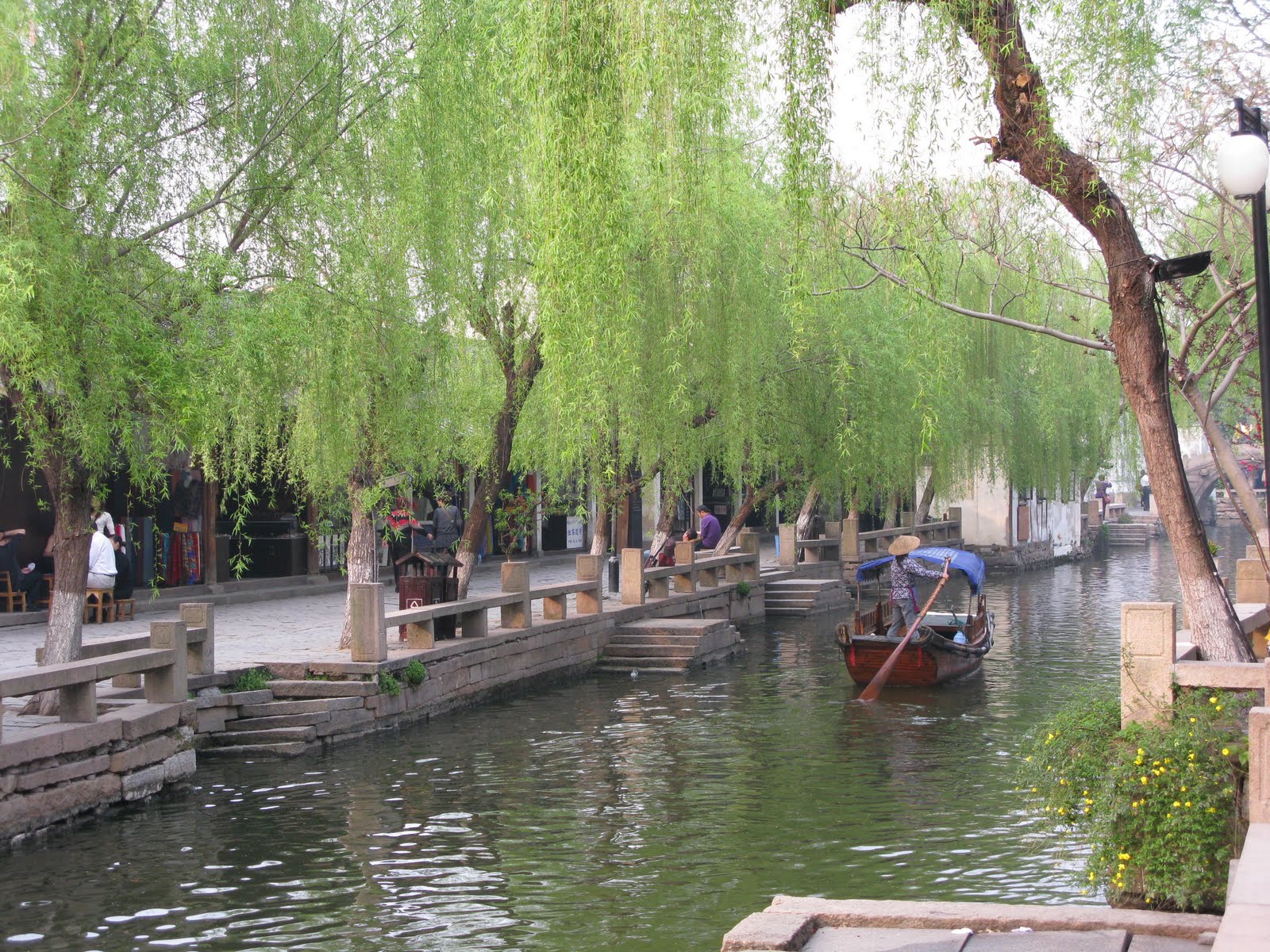
Thursday was an afternoon tour to the water city of Zhouzhuang.  It is a spectacular little hamlet with canals that cut through the town in place of streets.  The city was built around 1086 and has transformed into a very popular tourist destination for Chinese due to the level of preservation.  I was there in 2007 and it was very quaint, but Olga tells me that it has gone a tad commercial and the overall ambiance that I remember has been spoiled somewhat.  She returned around 9:30pm in the evening, tired and hungry, but glad she went. 


One of the many "streets" in Zhouzhuang 

A resident carrying goods the traditional way

One of the many bridges

Converted boats that used to carry goods, now only carry tourists


A quiet backstreet

Residential Area


Main Street

The main street with some boats

"Street" Side cafes

Traffic at the other end

I have run out of comments


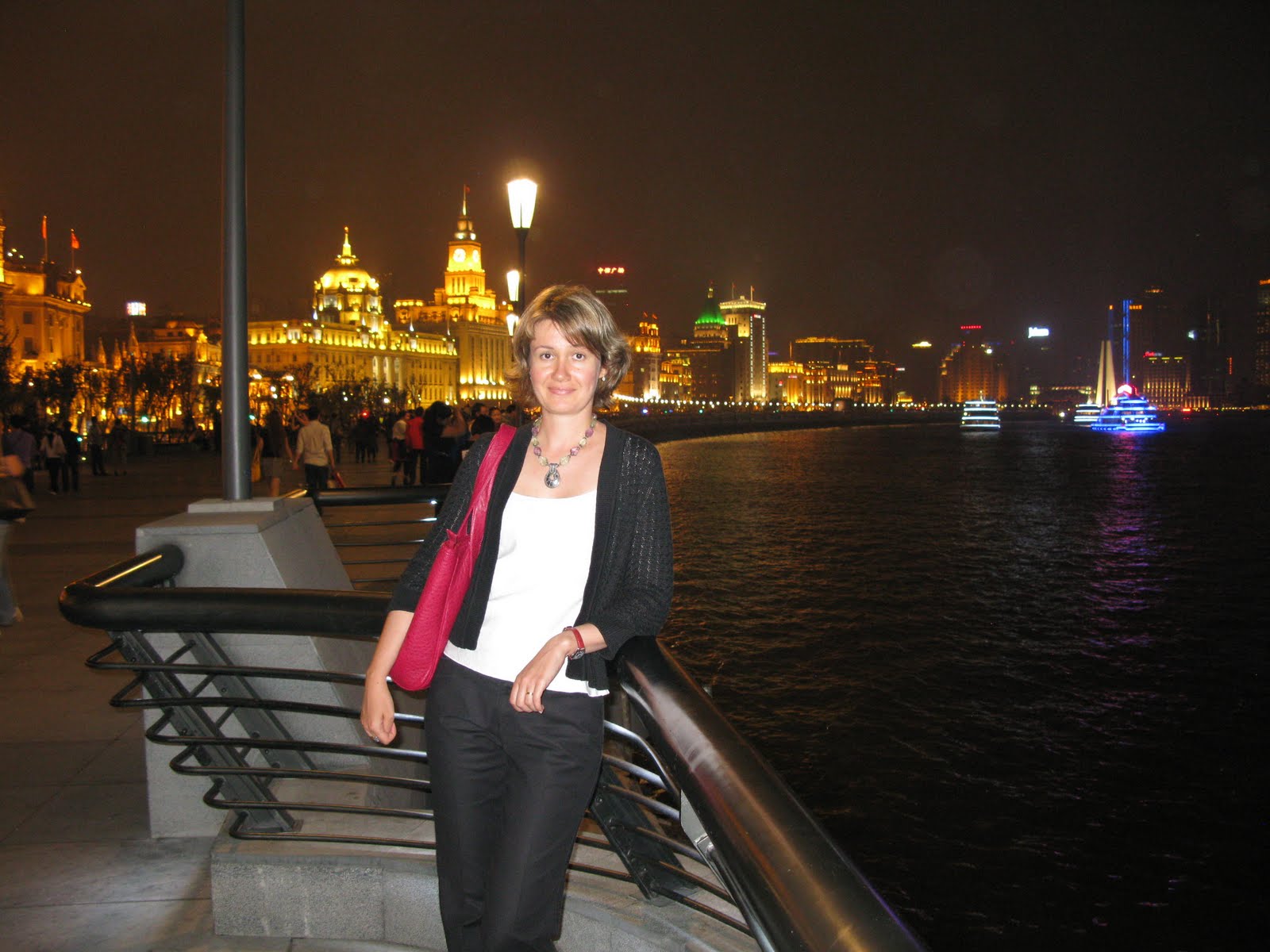
Friday finally arrived and Olga and I were able to enjoy breakfast together.  I had one more day of meetings and was tired and ready to go back to Delhi.  This conference always tires exhausts, as you have to be “on” from 7:00am until 10:00pm.  My meetings finished around 3:00pm and Olga and I had time to shop a little, grab a great dinner at a trendy Shanghai fusion restaurant called “Lost Heaven” and enjoy a romantic walk along the Bund.   It was a welcomed end to a long week!

Olga on the Bund

The Bund
Pudong as seen from the Bund
Our Hotel is one of the buildings are the right

The next day, we began the journey home with a brief layover in Hong Kong which put us into Delhi around 2:30am.  The desire and readiness to be back in Delhi lasted exactly until the sweet smell of body odor, urine and the heat of the night combined to say “Welcome Home!”

Sunday, April 24, 2011

Hangzhou


I apologize for not publishing any entries in the blog over the last two weeks, but we have been in China where blogging is illegal.  All blog sites are blocks by the Chinese Government in an attempt to ensure that the dreaded social media does not topple their government, as it seems to be doing in most other places these days.  Rest assured, though, I kept copious mental notes with which to regale forthwith.

We left a week ago Wednesday on our Chinese endeavor the purpose of which was actually work ... well, work for me.  My company has a massive gathering of global vendors in Shanghai each year in which thousands of people fly in from all corners of the world to talk business.  It is a huge event and done, as always, with the level of detail and style that only my company can provide.

The event did not actually begin until last Monday, but as we are trying to squeeze every drop of life and adventure from our Asian experience, we decided to go a little early and spend a few days in a quaint town outside of Shanghai (A quaint town in China is roughly 6 million people).  I first visited Hangzhou about 3 years ago on a sourcing trip and although I was only there for 24 hours, it left an impression on me. Olga had never been to China, so I thought this would be the perfect introduction.

Actually getting to Hangzhou was a little tricky.  We had to connect to Shanghai through Hong Kong on an overnight flight and then hop a train on the opposite side of Shanghai (a city of 30+ million people) for the last leg.  The total travel time was around 10 hours.  Airports are airports and I am completely comfortable navigating them whether in India, China Russia or Nepal, but train stations tend to be more parochial. In this case, though, I was amazed at how clean and efficient the station was with clear instructions concerning the trains and well marked departure points.  We settled in for the wait by grabbing a McDonald's hamburger and fries - mostly because it was the only thing available, but I must admit, I kinda wanted one.

The train was called exactly 15 minutes before departure time and we passed through an automated turnstile and down to the tracks.  Before us was the latest contribution to Chinese transportation - the Shanghai-Hangzhou High-Speed Train.  We boarded the pristine first class car and settled into our comfortable seats.  Having never experienced a high-speed train, I was actually pretty excited about going 220 Mph over land.  The train pulled out of the station and within minutes we were crossing the 200 Mph range.  It was pretty cool!

We arrived in Hangzhou and were met by the well-dressed, well-mannered driver from the Four Seasons.  He plunked us into the large, black Mercedes and we were off into the Hangzhou traffic.  Even though the roads were no less congested than India, the drivers kept to their lanes and off their horns.  To us, it was eerily quiet.   

We cruised through the modern streets that now carry the traffic through Hangzhou and could see remnants of the city’s grand past.  Hangzhou is an ancient Chinese city in both the literal and romantic sense.  The summer home to many emperors, it is considered to be one of the gems of China.  The city is fairly modern now, but what attracts people to the region is the lake that abuts the cities western edge named West Lake (the Chinese were never known for the creative naming).  The lake has taken on an almost mystical status within China and is associated with many poets, scholars and heroes of China’s past. Although almost totally man-made, the lake has been evolving since roughly 600 AD with its size growing and declining depending on the attention from the sitting government.  The current form of the lake began to take shape in the 15th Century and today the lake and the surrounding parks cover roughly 1,500 acres.

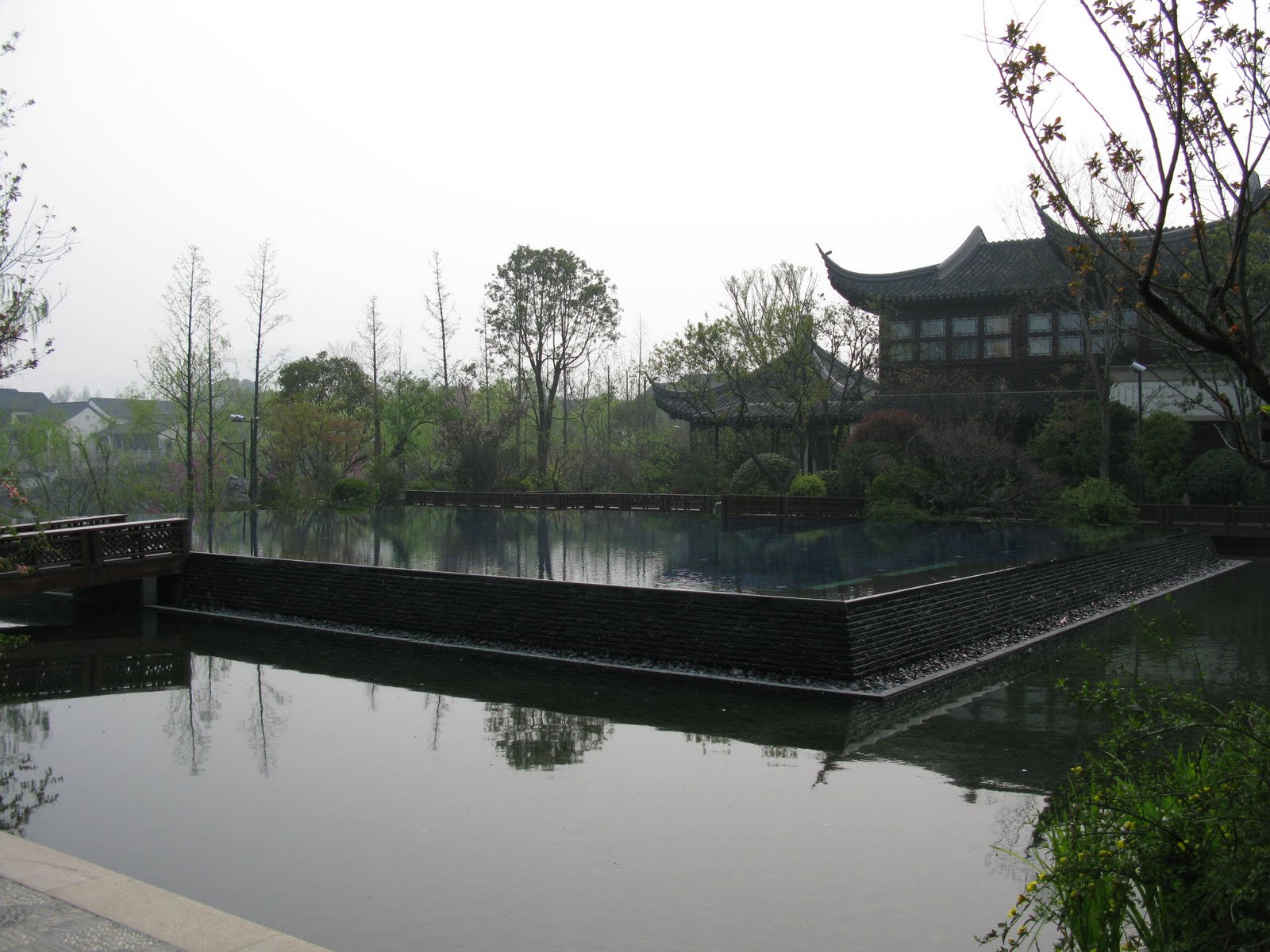
We arrived at the hotel about 30 minutes later and thanks to the complimentary bottles of water and cool face towels in the car, we felt pretty good.  The Four Seasons Hangzhou sits on the western most side of the lake in an area that has only recently seen development.  Due to the tight restrictions surrounding new construction, the Four Seasons had to create something that blended with the local environment and they succeeded admirable.  They have only 78 rooms, but the hotel sits on a sprawling, private campus that was indistinguishable from the surrounding parks. You could actually spend a half a day wondering just the hotel grounds and never feel like you missed out on anything in Hangzhou.


The rooms each had small verandas that led into a private courtyard


Olga relaxing on the veranda


Stream that runs through the Four Seasons Property


Four Seasons lagoon - The restaurant is on the left


Landscaping on the hotel property


More of the stream and covered walkways of the Four Seasons


Outdoor pool


Outdoor pool again with main lobby in the background


Venturing off the Four Season's property, you step directly into the extensive and meticulously maintained park system that surrounds the lake.  Decorated with ancient temples and traditional footbridges, you could walk for hours in the network of back rivers and wooded offshoots.  You share the area with elderly Chinese practicing Tai Chi, tourists taking photos and groups using the numerous pagodas to learn ancient instruments and songs.  It is truly a unique place.


A group of Chinese learning songs in the morning

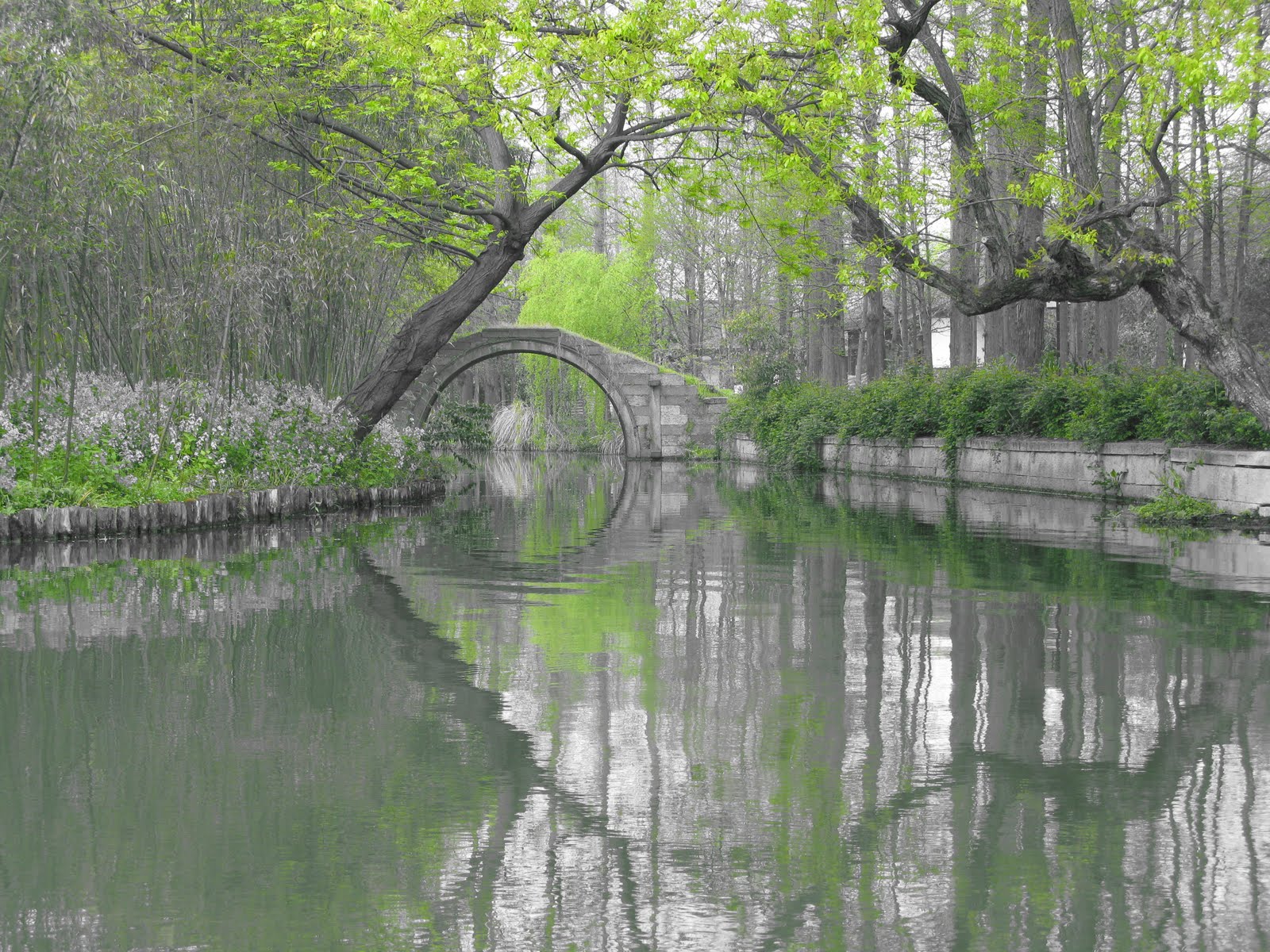
On our first full day, we arranged to have a traditional West Lake boat pick us up at the Hotel and cruise the back rivers and main lake for the morning.  Our oarsman was a pleasant fellow of few words who simply rowed the boat through the small riverways always attentive of not making too much noise with the oar and spoiling the tranquility. We floated under ancient bridges and through silent waterways for several hours until finally passing into the main lake.  In the middle of the lake was our destination, the Island of Little Oceans. 


The Riverways of West Lake from our boat


Olga enjoying the cruise
That is is Oarsman behind her


Romantic China


The tranquil backwaters


A small temple on the banks of the West Lake


Entering the main body of the West Lake


One of the many walking paths that criss-cross the lake
- it is only about 30 feet wide with more water on the other side


One of West Lakes many temples


Parks that surround the Lake


More of the surrounding parks


This small island consists of 4 small lakes within the island divided by a central walk way. The oarsman dropped us off on the island and we strolled through the ancient gardens.  Even though there were hoards of tourists, the place remained peaceful.  I credit the feng shui orientation of the island.  We ended the journey by being dropped off randomly on the side of one of the many pathways and wondered for the next few hours back to our hotel by foot discovering gardens and lakes along the way.  It was an excellent day.


On the Island 

The next morning, we decided to be a bit more adventurous and working with Robert (or Lobert, as he introduces himself), our concierge arranged a car and driver to take us on a tour of the backcountry of Hangzhou.  We began at the Ling Yin Temple about a 15-minute drive from the hotel.  The driver helped us purchase our tickets, pointed us in the proper direction and we set about up the long, wooded pathway into the mountains. 

Ling Yin Temple is actually a series of temples, grottos and rock carvings that occupy a fairly large portion of the side of a mountain.  The initial path is decorated with hundreds of rock carvings and grottos dating back to around 900 AD.  The modern path runs straight along the river, but the older path weaves through the carvings and grottos.  You have a choice, but I can tell you that the Disabilities Lobby in the US would have a field day with the older path.  We choose the more adventurous path until we were faced with crossing a crevasse with nothing more that a few stones jutting out from the hill.  We decided it would be more prudent to turn back rather than risk ending up in a Chinese hospital.  

Carvings and Grotto

Olga with Edna Mode (from the Incredibles)

More carving and caves

Buddha

The temple complex is equally impressive with a series of temples and outbuildings that have actively been used since the late 900s.  The place was packed with both tourists and pilgrims with the latter burning incense and chanting at each temple.  The entire area is still a working monastery and many people travel to Hangzhou to pray at these holy sites.  The halls rose up the side of the mountain with each one representing a different deity, group of deities or aspect of Buddhism.  The last hall was build as recently as 2002, but it was hard to tell the difference between them as they are all beautifully maintained.  


Pilgrams lighting incense

Buddha obscured by the smoke from the incense 

The main temple complex

Where the Pilgrims throw their used sticks

Leaving the temple area, we were told to continue down the path and this would eventually lead to a famous resort at which the hotel had booked us for lunch.  Before we got there, though, we were distracted by another series of buildings that headed up the mountainside.  This, we found out, was a new monastery, but it was virtually indistinguishable from the old one next door.  We spent the next 30 minutes climbing our way through the temples until reaching the top for a view of the valley and the lake in the distance. 

Entry to the new Temple complex


Olga next to the guardian


Chinese deities are not freindly


More Temples


... and another 


Lunch proved to be no less of an adventure.  After making our way down the mountain, we exited the complex into an area that looked and felt like an ancient Chinese farming village with several traditional houses spread out over several acres of land and a central road cutting through the middle. We walked the path for a while and happened upon what looked like a tradition teahouse from the 17th century.  It turns out this was our restaurant and we had been walking through the grounds of the famous Amanfayun Resort which has been on this spot for over 100 years.

Lunch was a fixed meal showcasing the best of the local cuisine.  I rarely take chances with my meals in China, but this was one of the best meals in one of the most unique locations I have ever experienced.  The restaurant was, in fact, called the teagarden, and was styled in the old teahouse manner.  I could not tell if it was an old house that had been there for centuries or a newly built replica, but either way it felt like it had been there forever. 

The Tea Garden
Inside the restaurant

Olga after the feast!

We finished the meal and were told that our driver was waiting for us up the road.  We found him and headed out to the last leg of the journey – to see were and how the famous Dragon Well, or Longjing Tea was harvested.

The car turned off the main road and began to climb a narrow lane up the mountain.  There was a great deal of traffic as this was the best time to come to this region – harvest time.  Apparently, the Longjing Tea is a spring tea and we were right in the middle of picking season.  We arrived at a small, but modern village at the top of the mountain full of cafés and fashionable restaurants.  Clearly the good people of the region understood that tea was not the only way to make a buck.  We stopped at a small store at the foot of a tea field and were invited to taste the tea that emperors have knighted as the best tea in the world.  It was bitter and tasted like feet.  To be fair, we came to understand that there are several varieties and grades of the tea, so what they were selling was not the best.  We did have some Longjing tea at the hotel the day before and it was superb, but apparently because we were Caucasian, the tea lady thought we were rookies. We thank her and left without buying the ludicrously expensive leaves. 

Tea fields 


The tea town


The tea picker


More tea town and fields

The tea leaves 

The flattening of the tea leaf

Upon returning to the hotel, we had one last adventure – the Four Season’s Spa. Spa quality varies from hotel to hotel, so I am always looking for the best spas globally – it is not that I enjoy it, but simple research.  Accordingly, I can tell you that this hotel’s spa is epic.  The spa is set up with a long corridor of flowing water with the spa rooms connected to a central walkway through the water that resembles rocks.  The whole experience seems like you are walking though an underground aquifer. The massage was great and I would rank this spa as one of the top two in the world (the other is the Mandarin Oriental in Bangkok).  Very relaxing!

Unfortunately, the next day, we reversed our steps and headed back to Shanghai where I had to begin work again.  All in all, though, it was a great break from the heat, noise and commotion of India and we look forward to doing it again next year!