Sunday, April 24, 2011

Hangzhou


I apologize for not publishing any entries in the blog over the last two weeks, but we have been in China where blogging is illegal.  All blog sites are blocks by the Chinese Government in an attempt to ensure that the dreaded social media does not topple their government, as it seems to be doing in most other places these days.  Rest assured, though, I kept copious mental notes with which to regale forthwith.

We left a week ago Wednesday on our Chinese endeavor the purpose of which was actually work ... well, work for me.  My company has a massive gathering of global vendors in Shanghai each year in which thousands of people fly in from all corners of the world to talk business.  It is a huge event and done, as always, with the level of detail and style that only my company can provide.

The event did not actually begin until last Monday, but as we are trying to squeeze every drop of life and adventure from our Asian experience, we decided to go a little early and spend a few days in a quaint town outside of Shanghai (A quaint town in China is roughly 6 million people).  I first visited Hangzhou about 3 years ago on a sourcing trip and although I was only there for 24 hours, it left an impression on me. Olga had never been to China, so I thought this would be the perfect introduction.

Actually getting to Hangzhou was a little tricky.  We had to connect to Shanghai through Hong Kong on an overnight flight and then hop a train on the opposite side of Shanghai (a city of 30+ million people) for the last leg.  The total travel time was around 10 hours.  Airports are airports and I am completely comfortable navigating them whether in India, China Russia or Nepal, but train stations tend to be more parochial. In this case, though, I was amazed at how clean and efficient the station was with clear instructions concerning the trains and well marked departure points.  We settled in for the wait by grabbing a McDonald's hamburger and fries - mostly because it was the only thing available, but I must admit, I kinda wanted one.

The train was called exactly 15 minutes before departure time and we passed through an automated turnstile and down to the tracks.  Before us was the latest contribution to Chinese transportation - the Shanghai-Hangzhou High-Speed Train.  We boarded the pristine first class car and settled into our comfortable seats.  Having never experienced a high-speed train, I was actually pretty excited about going 220 Mph over land.  The train pulled out of the station and within minutes we were crossing the 200 Mph range.  It was pretty cool!

We arrived in Hangzhou and were met by the well-dressed, well-mannered driver from the Four Seasons.  He plunked us into the large, black Mercedes and we were off into the Hangzhou traffic.  Even though the roads were no less congested than India, the drivers kept to their lanes and off their horns.  To us, it was eerily quiet.   

We cruised through the modern streets that now carry the traffic through Hangzhou and could see remnants of the city’s grand past.  Hangzhou is an ancient Chinese city in both the literal and romantic sense.  The summer home to many emperors, it is considered to be one of the gems of China.  The city is fairly modern now, but what attracts people to the region is the lake that abuts the cities western edge named West Lake (the Chinese were never known for the creative naming).  The lake has taken on an almost mystical status within China and is associated with many poets, scholars and heroes of China’s past. Although almost totally man-made, the lake has been evolving since roughly 600 AD with its size growing and declining depending on the attention from the sitting government.  The current form of the lake began to take shape in the 15th Century and today the lake and the surrounding parks cover roughly 1,500 acres.

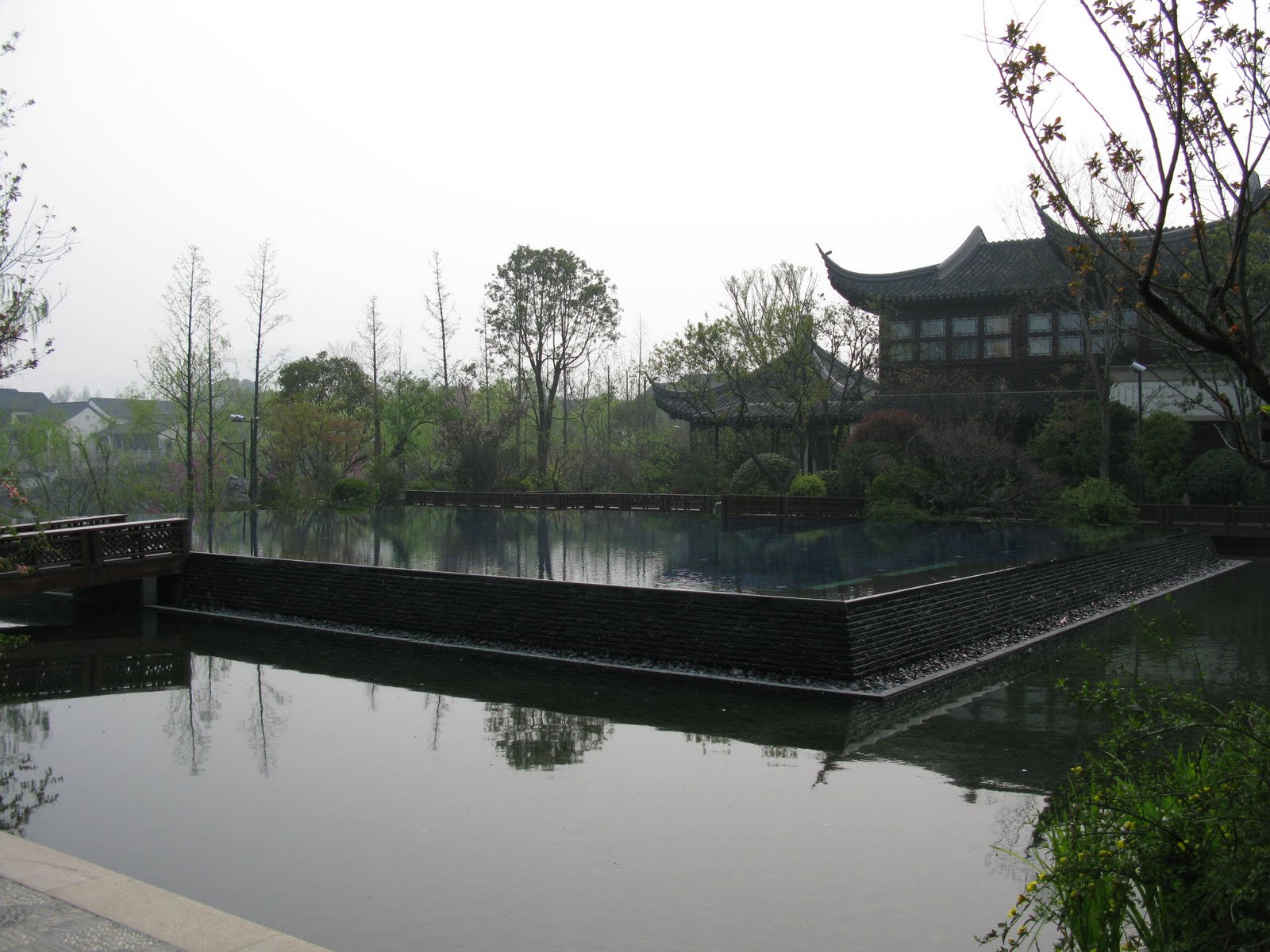
We arrived at the hotel about 30 minutes later and thanks to the complimentary bottles of water and cool face towels in the car, we felt pretty good.  The Four Seasons Hangzhou sits on the western most side of the lake in an area that has only recently seen development.  Due to the tight restrictions surrounding new construction, the Four Seasons had to create something that blended with the local environment and they succeeded admirable.  They have only 78 rooms, but the hotel sits on a sprawling, private campus that was indistinguishable from the surrounding parks. You could actually spend a half a day wondering just the hotel grounds and never feel like you missed out on anything in Hangzhou.


The rooms each had small verandas that led into a private courtyard


Olga relaxing on the veranda


Stream that runs through the Four Seasons Property


Four Seasons lagoon - The restaurant is on the left


Landscaping on the hotel property


More of the stream and covered walkways of the Four Seasons


Outdoor pool


Outdoor pool again with main lobby in the background


Venturing off the Four Season's property, you step directly into the extensive and meticulously maintained park system that surrounds the lake.  Decorated with ancient temples and traditional footbridges, you could walk for hours in the network of back rivers and wooded offshoots.  You share the area with elderly Chinese practicing Tai Chi, tourists taking photos and groups using the numerous pagodas to learn ancient instruments and songs.  It is truly a unique place.


A group of Chinese learning songs in the morning

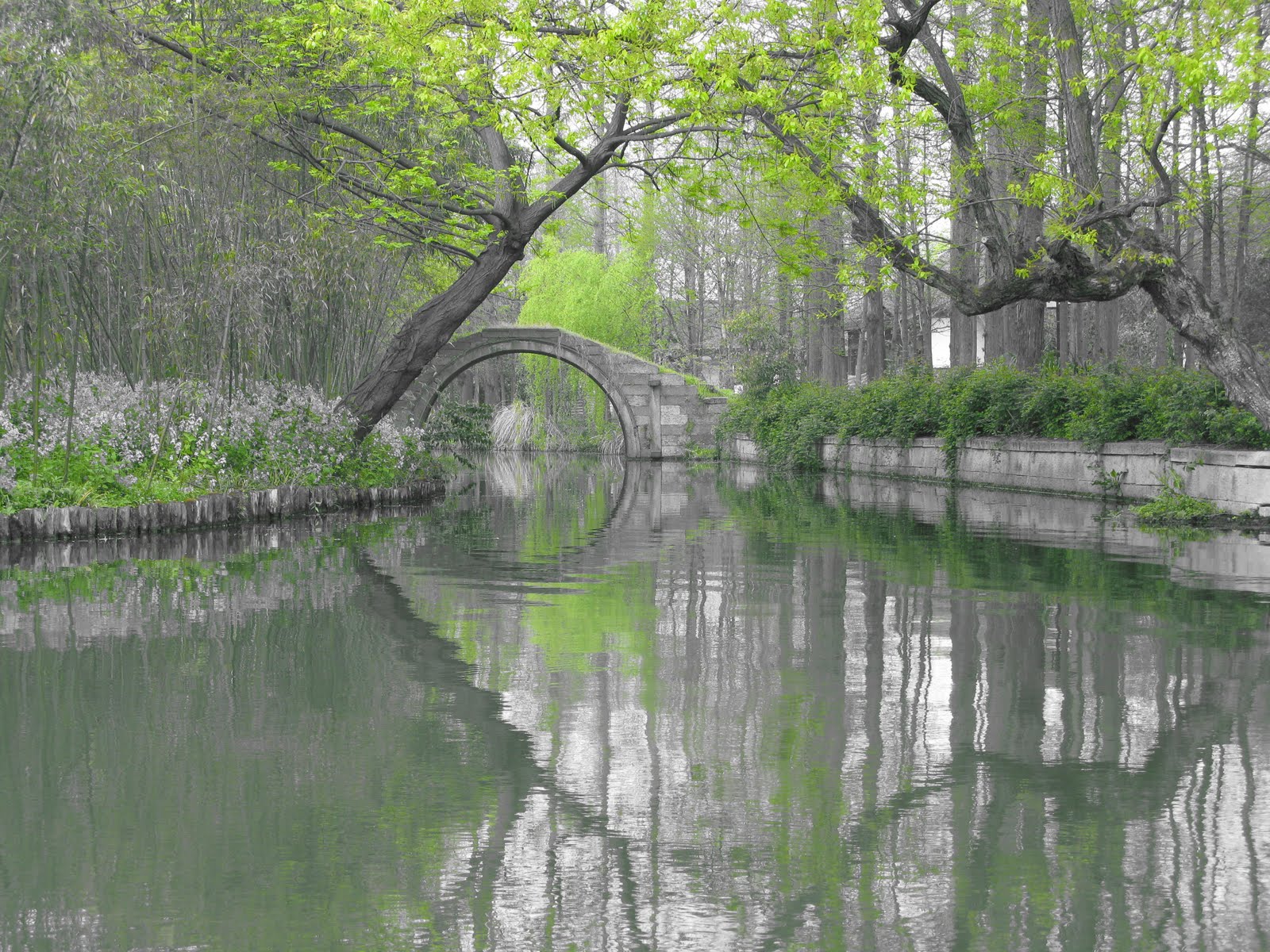
On our first full day, we arranged to have a traditional West Lake boat pick us up at the Hotel and cruise the back rivers and main lake for the morning.  Our oarsman was a pleasant fellow of few words who simply rowed the boat through the small riverways always attentive of not making too much noise with the oar and spoiling the tranquility. We floated under ancient bridges and through silent waterways for several hours until finally passing into the main lake.  In the middle of the lake was our destination, the Island of Little Oceans. 


The Riverways of West Lake from our boat


Olga enjoying the cruise
That is is Oarsman behind her


Romantic China


The tranquil backwaters


A small temple on the banks of the West Lake


Entering the main body of the West Lake


One of the many walking paths that criss-cross the lake
- it is only about 30 feet wide with more water on the other side


One of West Lakes many temples


Parks that surround the Lake


More of the surrounding parks


This small island consists of 4 small lakes within the island divided by a central walk way. The oarsman dropped us off on the island and we strolled through the ancient gardens.  Even though there were hoards of tourists, the place remained peaceful.  I credit the feng shui orientation of the island.  We ended the journey by being dropped off randomly on the side of one of the many pathways and wondered for the next few hours back to our hotel by foot discovering gardens and lakes along the way.  It was an excellent day.


On the Island 

The next morning, we decided to be a bit more adventurous and working with Robert (or Lobert, as he introduces himself), our concierge arranged a car and driver to take us on a tour of the backcountry of Hangzhou.  We began at the Ling Yin Temple about a 15-minute drive from the hotel.  The driver helped us purchase our tickets, pointed us in the proper direction and we set about up the long, wooded pathway into the mountains. 

Ling Yin Temple is actually a series of temples, grottos and rock carvings that occupy a fairly large portion of the side of a mountain.  The initial path is decorated with hundreds of rock carvings and grottos dating back to around 900 AD.  The modern path runs straight along the river, but the older path weaves through the carvings and grottos.  You have a choice, but I can tell you that the Disabilities Lobby in the US would have a field day with the older path.  We choose the more adventurous path until we were faced with crossing a crevasse with nothing more that a few stones jutting out from the hill.  We decided it would be more prudent to turn back rather than risk ending up in a Chinese hospital.  

Carvings and Grotto

Olga with Edna Mode (from the Incredibles)

More carving and caves

Buddha

The temple complex is equally impressive with a series of temples and outbuildings that have actively been used since the late 900s.  The place was packed with both tourists and pilgrims with the latter burning incense and chanting at each temple.  The entire area is still a working monastery and many people travel to Hangzhou to pray at these holy sites.  The halls rose up the side of the mountain with each one representing a different deity, group of deities or aspect of Buddhism.  The last hall was build as recently as 2002, but it was hard to tell the difference between them as they are all beautifully maintained.  


Pilgrams lighting incense

Buddha obscured by the smoke from the incense 

The main temple complex

Where the Pilgrims throw their used sticks

Leaving the temple area, we were told to continue down the path and this would eventually lead to a famous resort at which the hotel had booked us for lunch.  Before we got there, though, we were distracted by another series of buildings that headed up the mountainside.  This, we found out, was a new monastery, but it was virtually indistinguishable from the old one next door.  We spent the next 30 minutes climbing our way through the temples until reaching the top for a view of the valley and the lake in the distance. 

Entry to the new Temple complex


Olga next to the guardian


Chinese deities are not freindly


More Temples


... and another 


Lunch proved to be no less of an adventure.  After making our way down the mountain, we exited the complex into an area that looked and felt like an ancient Chinese farming village with several traditional houses spread out over several acres of land and a central road cutting through the middle. We walked the path for a while and happened upon what looked like a tradition teahouse from the 17th century.  It turns out this was our restaurant and we had been walking through the grounds of the famous Amanfayun Resort which has been on this spot for over 100 years.

Lunch was a fixed meal showcasing the best of the local cuisine.  I rarely take chances with my meals in China, but this was one of the best meals in one of the most unique locations I have ever experienced.  The restaurant was, in fact, called the teagarden, and was styled in the old teahouse manner.  I could not tell if it was an old house that had been there for centuries or a newly built replica, but either way it felt like it had been there forever. 

The Tea Garden
Inside the restaurant

Olga after the feast!

We finished the meal and were told that our driver was waiting for us up the road.  We found him and headed out to the last leg of the journey – to see were and how the famous Dragon Well, or Longjing Tea was harvested.

The car turned off the main road and began to climb a narrow lane up the mountain.  There was a great deal of traffic as this was the best time to come to this region – harvest time.  Apparently, the Longjing Tea is a spring tea and we were right in the middle of picking season.  We arrived at a small, but modern village at the top of the mountain full of cafés and fashionable restaurants.  Clearly the good people of the region understood that tea was not the only way to make a buck.  We stopped at a small store at the foot of a tea field and were invited to taste the tea that emperors have knighted as the best tea in the world.  It was bitter and tasted like feet.  To be fair, we came to understand that there are several varieties and grades of the tea, so what they were selling was not the best.  We did have some Longjing tea at the hotel the day before and it was superb, but apparently because we were Caucasian, the tea lady thought we were rookies. We thank her and left without buying the ludicrously expensive leaves. 

Tea fields 


The tea town


The tea picker


More tea town and fields

The tea leaves 

The flattening of the tea leaf

Upon returning to the hotel, we had one last adventure – the Four Season’s Spa. Spa quality varies from hotel to hotel, so I am always looking for the best spas globally – it is not that I enjoy it, but simple research.  Accordingly, I can tell you that this hotel’s spa is epic.  The spa is set up with a long corridor of flowing water with the spa rooms connected to a central walkway through the water that resembles rocks.  The whole experience seems like you are walking though an underground aquifer. The massage was great and I would rank this spa as one of the top two in the world (the other is the Mandarin Oriental in Bangkok).  Very relaxing!

Unfortunately, the next day, we reversed our steps and headed back to Shanghai where I had to begin work again.  All in all, though, it was a great break from the heat, noise and commotion of India and we look forward to doing it again next year!   

Saturday, April 2, 2011

Cricketeers

This past month the World Cup of Cricket, the only World Cup according to the subcontinentals, has been held in Sri Lanka, Bangladesh and India pitting national cricket teams from all over the world in an epic struggle for crickets most coveted prize. In this time, cricket fever has infected most of India as the home team has won all of their matches thus far and have made their way to the semi-finals. Not hailing from a Commonwealth country, I have for the most part sat on the sidelines and watched as India has been engulfed with cricket madness. All that changed Wednesday.


On Wednesday, India met Pakistan for the semi-finals of the World Cup. Firstly, you must understand that in Pakistan and in India, cricket is a national obsession. I compare it with the Brazilians and soccer/football except the Brazilians are actually consistently good. From Lahore to Mumbai, this sport is viewed with passion and when India loses clutch matches, it is not uncommon for many things to get broken in India.


The second reason that this match is so important is that India and Pakistan love to hate each other in everything. Having been the same country and the same people for centuries, Indians and Pakistanis have the relationship of a mother and a daughter that share the exact same mannerisms – never good. Over the years, the two countries have officially and unofficially poked each other politically, militarily, economically and now athletically. This is the type of rivalry that makes for seriously good sports whether its hockey, football or, well, cricket.


I must admit having lived here for almost a year, I have taken no interest in Cricket. I have made no attempt to learn the game or even pretend to be interesting in the national game. I realize that it is culturally insensitive, but I got a lot going on –like trying to get my internet working. Like any mob mentality, though, be it mullets, jeggings or Al Gore, the fever finally got to me, as well.


The match was to begin at 2:00pm on Wednesday which presented the obvious problem of no one showing up to work that day. Could you image if the Super Bowl was played at 2:00pm on a Wednesday? To circumvent the issue and to show what a culturally sensitive boss I was, I installed a satellite TV in the cafeteria and invited the entire office to watch to watch the match, well actually part of the match since it would actually go until 10:30pm that night. They loved it!


Now, as the boss, I couldn’t actually not show up for the match, so at 2:00pm, I trundled to the cafeteria to sit with a very enthusiastic group of cricket fans who were eager to explain ever aspect of the game. Since I believed that a sport is not actually a real sport unless you run of risk of injury while in full and constant contact with your opponent, I was pretty convinced that Cricket had the appeal of Kenny G in a skirt. After 2 hours of being schooled on the rules and idiosyncrasies, though, I must admit I got sucked in.


At first, the game simply looked like a more complicated, less orderly version of baseball. The pace was slow, the players looked bored and there was more commentary than action. As the game progressed, though, there are subtleties in cricket that the baseball simply cannot replicate. For instance, the teams only bat once, so basically the team that bats second is in a long, dramatic catch up phase. Since the scores are in the 200-300 range, it is a long and painful process with periods where they look like they are on target to win and periods where all hope is lost. You can never answer the question “who’s winning?” until the final ball has been bowled. After 3 hours, I had a layman’s understanding of the game and was hooked.


In the end, India squeaked out a victory and the nation went into a national celebration. All night fireworks exploded and people cheered in the streets of every city and village. It was irrelevant that this was a semi-final match, as Pakistan had been vanquished and all was right with the world as far as every Indian was concerned. There is still the final match to be played against Sri Lanka on Saturday for the actual World Cup, but as far as India is concerned, that is just a bonus. The real match was played on Wednesday and I was a fan!

Thursday, March 31, 2011

Truth in Advertising

Despite the impression of India as a major economic threat to the developed world, the Indian economy is a house of cards built on a mound of sand. Taught by the business savvy Soviets in the 1970s, Indians have structured their large companies so poorly that I think it even amazes them that they are still functioning. Everything from automotive, to petro-chemical to manufacturing revolves around profit taking, corruption and short-term gain. The products and services they offer are about convenience to the corporate heads rather than consumer desire. It is a “you’ll take want we offer you” market!


Last year when we arrived, we signed up for internet service. They had several plans ranging from the ridiculously low speed to 1 Mbps (which has not been seen in the US for 10+ years) to the blazing speed of 4 Mbps (I believe in Minneapolis the lowest speed you can get is around 25 Mbps). In addition, they offered two types of plans at all their speeds: One was called the unlimited plan and the other, the limited plan. The Limited Unlimited Plan, as the name implied allowed you to download a limited amount after which you would need to buy additional capacity or your internet ceases to run until the next billing cycle. The Unlimited Plan allows you to download an unlimited amount of data. But in India, not all is what it seems and if there is an angle to be played, they will play it.


Last year, as I was saying, we signed up for internet service. We choose the 4 Mbps, unlimited plan and shortly after were hooked up and surfing merrily. It, though, seemed my merry surfing was a bit slow, so I checked the speed and discover we were actually surfing a much smaller wave. Rather than 4 Mbps we had purchased, we were at 2. I called the representative who sold us the contract, set up our system and subsequently collected the commission and told him the issue. He, without skipping a beat, told me that 4 Mps was simply not available in my area and the fastest I could get would be 2. I, then, asked the obvious question – “Why, then, would you sell me 4, if you knew it was not available?” After a few seconds of silence, we moved on. He corrected the bill and I put the incident behind me as a one-off incident. I was very, very naive.


This month, we downloaded a lot of stuff and found out what unlimited really means. You see, at AirTel, one of India’s largest telecommunication companies, they have a clause in each contract called the “Fair Usage Policy.” Under this policy, the unlimited plan becomes the Unlimited to a certain point plan. When you read the fine print, the Unlimited Plan actually limits the amount you can download at the agreed upon speed, but allows you to keep downloading (that would be the unlimited part) but at a ridiculously slow speed of 256Kbps. To put this in perspective, there were dial-up, phone modems that were faster than that in the early 90s, so in essence, the unlimited Plan is, in fact, limited, unless the only thing you want to do is watch the Google search page load for 30 seconds.


To rectify this, I called the AirTel customer service line last night. The first amazing thing is that even to change your plan and give them more money per month, they charge you for the call. They own the phone lines and are paying the customer service reps, but they still charge to a few bucks just for the privilege. Already pissed about the aforementioned two issues, this one really put me over the edge.


When the rep finally answered, I explained the situation and asked to have my internet speed and capacity expanded to rectify the situation. She said that this could not be done until the next billing cycle, but I could buy additional capacity at 2Mbps on an hourly rate for roughly the same price as I would pay for a week. Ah, the scam is exposed. Even though there is plenty of capacity, they have set up the plans to sell you more. Now, I was outraged! I asked a few rhetorical questions like “does anyone actually fall for the scam?” and “are you paid on commission?” She was less enthusiastic about answering these than the questions about the plan! It is pretty amazing when you think about it. The idea is that you create a scarcity of a product that is in no way, shape or form scarce.


I eventually calmed down (read, stopped using my outside voice) and told her to upgrade the plan, but before she did it, I requested she check to make sure the speed was available in my area based on my past experience. “Fool me once” and all! She said that she could not actually check to see if the speed was available, but she would put in for the plan change to 4Mbps and someone would do a check. I assume the same someone that did it the last time, so I asked to be transferred to someone who could answer my question. Over the next 30 minutes, I talked to colleagues and supervisors at AirTel, but not a single person could tell me if the plan for which I was going to be charged existed. Again, genius! Sell a product you have no intention of providing and can only be verified by someone with the correct knowledge. Add a little artificial rationing and you have yourself a license to print money. Caveat Emptor!


Now many of you are saying, well India is a market economy and completion would keep this under control. Well, you’d be wrong. Every telecommunications company has the exact same deal for the exact same price. They also do not have anti-trust laws. Hum?


So, I guess we will have to wait for the next billing cycle and see what happens! In the mean time, I will spend the next 45 minutes uploading this blog.

Sunday, March 27, 2011

Grass


Any homeowner in the US knows about grass.  This is an essential social skill of living in a neighborhood, be it the country, suburbia or the city.  We believe one can tell a lot about a person by their lawn and hold people accountable accordingly.  A poorly maintained, browning, overgrown lawn would bring not only the scorn of neighbors, but in some parts, a fine from the city or homeowners association.  When you buy a house, you need to know your grass. 

I have had a long and tenuous relationship with my lawns starting with my first house in Florida almost 20 years ago.  I had no clue about grass and paid a terrible price for it.  Who knew that when they lay sod, you had to water it or it would die and be replaced by an indestructible army of weeds.  Who knew?  There is no class on this; no instructions on the sod – only the scornful looks of neighbors and the occasional nasty, anonymous note.  But even the notes do not have any words of guidance, they just say, “quit embarrassing us and get your shit in order.” Eventually, over the next two decades, I learned techniques and tricks in the art of maintaining a lawn and, over that time upgraded my status from scorned to scorner.  Also, as I have moved from home to home (4 in all), I have reduced my grass footprint significantly and this, I can tell you is the best technique of all.  I mean, what moron cannot keep a 10 x 10 plot of grass green and mowed.

In moving to India, I noticed that they neither had the same passion around nor need for the green ground covering.  Firstly, for such a green city (and by green I mean many trees, not environmentally conscious), Delhi has a surprising dearth of grass.  Paths in the Delhi parks wind through beautiful trees and bushes surrounded by wide-open areas of mud.  Even in the office complexes, where there has been a clear effort to plant and maintain grass, there are expansive swaths of mud.  I say mud, as they have no topsoil here, but heavy clay & sand soil on which they dump copious amounts of water in an effort to make things grow in it. 

The reason I am on about grass is that the geniuses that built our office building have finally decided to take care of the trash heap that abuts our building and create a green-space. The building has been completed for 3 years, but apparently this was not a priority (we also do not have a paved road, bit more on that another time).  The space, or as I call it, the trash heap, for my first year was a mixture of construction debris, garbage and the occasional family dwelling.  I had become used to the morning routine of the trash heap and when the cadre of guards came out to pee, I knew my day had truly started. Now, though, they have decided to “improve” the land and I have a new form of entertainment – grass planting. 

The process began over two months ago when the weather was hovering around the mid-70s and rain was occasional, albeit not frequent.  A good time to plant grass.  One day, a bulldozer was unloaded on the edge of the heap and after the usual smoke break, pee break and nap, the Delhi workers began to push all the debris into the neighboring building’s abutment.  In India, we would never actually clean up anything, when there is a perfectly good lot next door in which to dump your crap.  It just makes good sense!  This Process took roughly a week to accomplish as the area is large, the trash was deep and there was a lot of napping and peeing that needed to happen by the workforce. 

Once the area was cleared and flattened, a group of women arrived to remove the rocks and stones from the area.   Yep, four women crouched on the ground, picked through the dirt of an area the size of a football field and removed each rock and stone by hand.  Very impressive!  It took them roughly two weeks to complete their task and the only break they took was lunch.  Union workers could learn a thing or two from the women of Bihar!

With the land rock-free, I was sure that the sod would arrive soon.  I was wrong.  A week went by and then another with no activity in the void.  Each day, I held my excitement for the next stage!  Finally, just when I could take it no more, trucks began to arrive with dirt.  As I mentioned, the soil here is hard clay, so this was a promising sign.  Maybe someone really did know how to grow grass.  The soil-men jumped on the backs of the trucks and shoveled the soil into large piles around the pitch.  As they did, another group spread it out.  This was actually very effective and within the week the ground was ready.  Again, though, weeks went by before the next group arrived. 

Finally, a few men arrived with large sacks of fertilizer and began throwing it around the area.  A big clump here, none there.  This went on for a few days until they felt satisfied that the bags were empty.  A tractor then churned the mixture and made for a nice fertile planting area.  “OK,” I thought, “now we are getting somewhere.”  But, alas, we were not.  The field fell idle for several more weeks as the foot traffic pounded the churned, loose soil back into hardpack.

By now, the temperature was climbing into the high 80s and, although still pleasant, the rains were noticeably absent and the ground was starting to dry out.  There was speculation in the office that this was as far as they would go and the trash, pee and families would be back in a few weeks.  Others were more optimistic.  I was simply curious. 

Then, one morning, a group of men and women appeared on the field and dumped sacks of grass cuttings, albeit not fresh looking grass cuttings, into large piles at the edge. I watched in amazement, as the group used a small tool to make a hole and then jammed the tuff of brown and gray grass into the divot.  They methodically started at one end and over the coarse of the next two weeks, planted tuffs every ½ foot or so over the entire area.  As they completed each section, a person would come out with a hose and completely drown the grass against the heat and unrelenting sun.  Day by day, this continued until finally, last week, the entire area had been “planted.”  Little tuffs of dead grass stuck into a muddy field in 100-degree heat and no chance of rain for 5 months.


Planting the tuffs


The finished product


Watering 


Hosing the entire area late in the day
Temp 97 degrees


Around the office, we had much discussion concerning what I felt was the folly of the grass planted, but no one else seemed worried.  There is a general optimism that this is how grass is planted and in a few months, we will have a lush lawn out our window.   I have decided that if lush green grass emerges, I am sending a bag of these magic grass cutting to my sister in Arizona to plant during the summer, because clearly the Indians have found a way to make grass grow without seed or sod in the blazing heat.

We shall see!

Sunday, March 20, 2011

Holi


Today is one of the biggest holidays of the year in India – Holi.  Officially, Holi is celebrated on the last full moon of the lunar month, Phalguna, and bids adieu to the winter season and welcomes the spring.   There is a lot wrong with this holiday, though.

Firstly, it is celebrated by people running in the streets throwing colored powder or balloons filled with colored water at each other and indiscriminately at passers–by.  This means that if you are on the street, odds are you are going to get nailed with something and that something is virtually impossible to get out of your clothes, hair and skin.   Even passing cars are not above the occasional ambush in the name of bringing good luck to the spring.

The other issue I have with this is the timing.  When you read the description, you would image that we have emerged from the cold and wet months into a beautiful, blossoming spring.  The reality is that Feb and March typically has excellent weather with temperatures in the high 70s.  What we are actually welcoming is the blisteringly uncomfortable heat of the Delhi dry season.  In the week leading up to Holi the temperature has steadily risen from 78 last Saturday to 100 yesterday.  This is not Spring – this is summer in Hell!

So while the rest of Delhi celebrates Holi, Olga and I are barricaded in our apartment trying not to get splattered with the dye or stroking from heat exhaustion as the temperatures head north of 100. 

Happy Holi!

Wednesday, March 9, 2011

Coming Down with Something


“Coming down with something” in India is a bit different than getting sick in the United States.  In the US, for instance, when your stomach starts to feel upset, you dismiss it as “something that did not agree with you” or if it is extreme, then it must be food poisoning.  You take a few over-the-counter elixirs to settle the discomfort and you go to bed happy in the thought that by tomorrow, it will all be gone.

In India, the thought process it slightly different.  You hope that it is “something that did not agree with you,” but you pray this is not a long-term argument.  You hope it is food poisoning, but you pray that it is not the kind that eats away at your organs and leaves you to die in your own bile.  You do not go to bed happy with any thoughts, but you stay awake combing your mind for what you possibly got on your hands or ate and struggle to feel the first signs of your lungs shutting down.

The reaction by those around you is also different.  In the US, people say,  “go home and rest.”  In India, everyone orders you to go to the doctor.  They do not, though, do it in the “well, if you don’t feel better, you should go to the doctor” way, but they say it in a “you should urgently make a beeline for a hospital before it is too late” way.  Now, in all fairness, in India, they do go to the doctor every time they feel even the slightest bit off, but for an American, this is very disconcerting – as if they know something that you don’t.

Lastly, there is the journey to the hospital if, in fact, the worse case scenario happens.  In the US, your local 911 operator dispatches an ambulance to your home and a few well-trained, people jump out, hook you to whatever needs-a-hooking and you are whisked away on a speedy journey in which all traffic parts for you like the Red Sea.  In India, an ambulance, or rather a smallish van that says “Abmlance” will show up… eventually.  When it does, the driver and co-pilot will hop out and, well ring your doorbell.  You make your own way to the ambulance and then you join the other 13 million people trying to get to wherever it is all of you need to go.  Although they have a siren, absolutely no one pays any attention to it.  Travel time to the hospital can be well over an hour. 

All in all, the mere thought of getting sick is far worse the sickness itself … or at least I hope it is!

Saturday, March 5, 2011

The Long Walk

The next morning, I arose to the most unbelievable view.   The sun had just cleared the mountains in the east and was casting its first light upon the Himalayas.  In the distant valley below, you could hear the roosters waking their owners to the new day.  I sat on our patio and watched as the world at my feet begin to stir and, eventually, a few hours later, Olga arose to join the living.   We had breakfast on the terrace in front of the main house and were treated to farm-fresh egg omelets with just-picked vegetables complimented by homemade bread, jams and yak cheese.   Just what you need to begin a day of trekking though Nepal!

Today we were planning on hiking to the town of Panauti. By car, Panauti is about an hour drive, but we were taking the shortcut over the mountain, so by Surendra’s estimates it should take us only about 4 hours to walk there.  Having lived in Oregon and having hiked almost every weekend we could while we lived there, we had all the right gear! We had the right footwear, the right daypack, even a hiker’s first aid kit and compass.  Lessons learned from being lost in the Oregon forests while snowshoeing.  Surendra drew us a small map on how to get there that consisted of a squiggly line to a stupa, another squiggly line through the word “forest” that said had “no left” highlighted and finally a straight line from the forest to Panauti that said “flat.”  What could possible go wrong while hiking through the Nepalese backcountry with that kind of first class orienteering?  …. And we were off!

The first part was pretty easy.  The track was wide and the footing was solid.  It was an old cow trail that took us through the untouched Nepal.  We passed through people’s farms and within spitting distance of their doorways (don’t ask how I know that).  Most did not blink or even notice us.  What a difference from Kathmandu, and Delhi for that matter, where white skin always equals a business opportunity.  Families sifted their wheat or tended to their goats, but never thought of us as anything other than travelers.  This theme continued for the entire trip.  It was very disarming and reassuring.


As we began the Long Walk


Looking back at the farm


Tiered farmland and mountains


The valley and mountains looking east


If you can stand on it, they will farm it


Wheat


A long way down


Our destination was somewhere over there.....


We passed by spectacular views of the mountains and valley below. We walk next to tiered plantings of wheat and rice and through vegetable gardens full of cabbage and peas.  We trekked passed families doing what they do everyday and children curious to see the stranger with light eyes.  It was the kind of trek, I imagine, is very common in Nepal, but it felt very unique to us


Curious Children


Local residence and barn

We eventually found the stupa which sat in a small clearing peering out at the mountains beyond.   Beyond the stupa, there was a massive pine forest as outlined on the map, but there were several paths leading into the forest and, to be honest, we hadn’t a clue which was the right one.  After some consternation, we took the first path, as it seemed the most accessible.  15 minutes going vertically up on this goat trail and we realized that maybe going up was not the right direction.  We turned back and asked a farmer in the vicinity of the stupa for directions.  He pointed to another path, grinned and disappeared.  We set out into the forest for a second time.   


The Stupa
Note the brick drying in the lower left corner
- the houses are made from these mud bricks


Trekking through the forest was a little more difficult than the first segment.  The path was much more narrow and not all that well used.  This certainly was not the well-maintained, groomed trails of Oregon.  This was the path people used to get to the next town on the rare occasion they went to the next town.  What made it more difficult was that the trail was a constant downward grade.   This, of course, is better than an upward grade, but too much of anything is not good.  About an hour into the forest, we felt like there may be no clear way out.  The path just kept snaking through the trees up a little, then down a lot.  Every now and again, you would catch a great view of the valley below, but it never seemed to be getting any closer.  Finally, we popped out of the trees onto an open path that looked like it was the start of a roadwork that never quite got the funding.  Never the less, we were out of the forest, albeit the cool, shady forest, and directly into the completely unfiltered noon sun.


The forest and the never-nearing valley


"The woods are lovely, dark and deep"


"And miles to go before I sleep"


Finally we reached the valley floor

The uncompleted road led us down through a farming village that I assumed had seen more prosperous days.  Some of the houses were quite old with intricate woodwork like we saw at Dwarika’s Hotel, but all the houses looked like our little cottage, except these had livestock living on the first floor and no glass in the windows, only the shutters.  This was typically what we saw on the entire journey down the mountain, but this setting seemed more urban, so they looked more weathered and worn. 


We started down the road – which was flat as indicated on the hand-drawn map.  What was not indicated was exactly how much further we had to go.  The road ahead went up a grade and disappeared beyond it, so there was no telling.  We pushed on into the back half of hour number three.


Happily and Joyfully marching on!


The road wound across the valley and traversed several large farms.  The valley, itself, was relatively flat, but these fields still tiered with the natural contour of the valley floor.  Where western farmers would have plowed flat the earth, the Nepalese used the ebb and flow of the valley to push the water through the crops.  I am no farmer, but it looked pretty efficient.  What was really striking was the amount of farmland.  It was on the valley floor, up the sides of the mountains and across the summits.  If it could be farmed they farmed it.  And by “they”, I mean the women. 


The village we passed through
The forest on the mountain is from whence we came


More road traveled


Tiered valley floor


More farmland


The other striking feature we saw throughout the entire day was that the women did all the work while the men sat in the doorways shading themselves and smoking.  Not bad work if you can get it.  The result was that the young Nepalese girls are striking with their Indo-Asian looks, but the older women looked worn, tired and stooped over. 


Woman Farmer


We continued walking though the valley and by this time, we were tired and hungry which means we were both a little grumpy and ready to end this adventure. To the side of the road, structures started to appear more frequently, but the curvature of the road provided no clue to how much further we had to go.   Finally, we crested a bluff and spayed out before us, albeit several kilometers in the distance, was Panauti greeting us with her golden temples. With a renewed sense of purpose, we marched toward the pagodas for another hour or so and finally reached the ancient city.


Panauti


Almost there


Panauti was founded in the 1200s and is one of the oldest cities in Nepal.  It is adorned with many temples including one dating back to the 1294 in which young couples hang pots in the upper floors of the pagoda for a happy and prosperous family.  The town feels old and some of the buildings look like they have been there since the beginning of time.  Unfortunately, we were so tired that we more or less blew through the town en route to the rendezvous point with the driver who would drive us back up the mountain.   It was, to say the least, a long walk!


The ancient Temples of Panauti


More Temples


Where one would hang a pot for prosperity 


The not so modern streets of Panauti


The local laundry-mat


When we returned to our temporary home in the clouds, the place was abuzz.  Several new people had checked in and we were no longer alone.  Still, the compound felt peaceful and quiet and since I could no longer feel my legs, I was happy to sit in my piece of paradise and watch the world go by. 


Dinner that night was slightly more lively with the addition of a Frenchman who spoke no English, his translator and two American girls in their early 20s trying desperately to sound consequential.  The meal was fantastic, the conversation good and it all ended too soon.  We said our good-byes and parted for bed.  We had an early departure in the morning and needed our sleep.

6:00am came quickly and was most unwelcomed in our hut.  I got up and darted outside to see the landscape before the sun crested the mountains.  The Himalayas, being roughly 4000 meters higher than the surrounding mountains, caught the sun before it actually rose and took on a pink hue.  Finally the sun winked over the mountains in the east and filled the sky with light and warmth.


The last day arrives


We took our breakfast in front of the main building and watched the sun continue break through the morning fog that blanketed the valley beneath us. The breakfast was similar to the day before complete with all the organic, natural vegetables, but this time, it was complemented with an incredible sunrise bouncing off the Himalayas.  Not a bad way to have your coffee.   

We departed soon after and as we re-entered the crushing reality of modern society, we began to regret our decision to come down off our mountaintop.